
Continuous Security Validation vs. the Annual Pentest
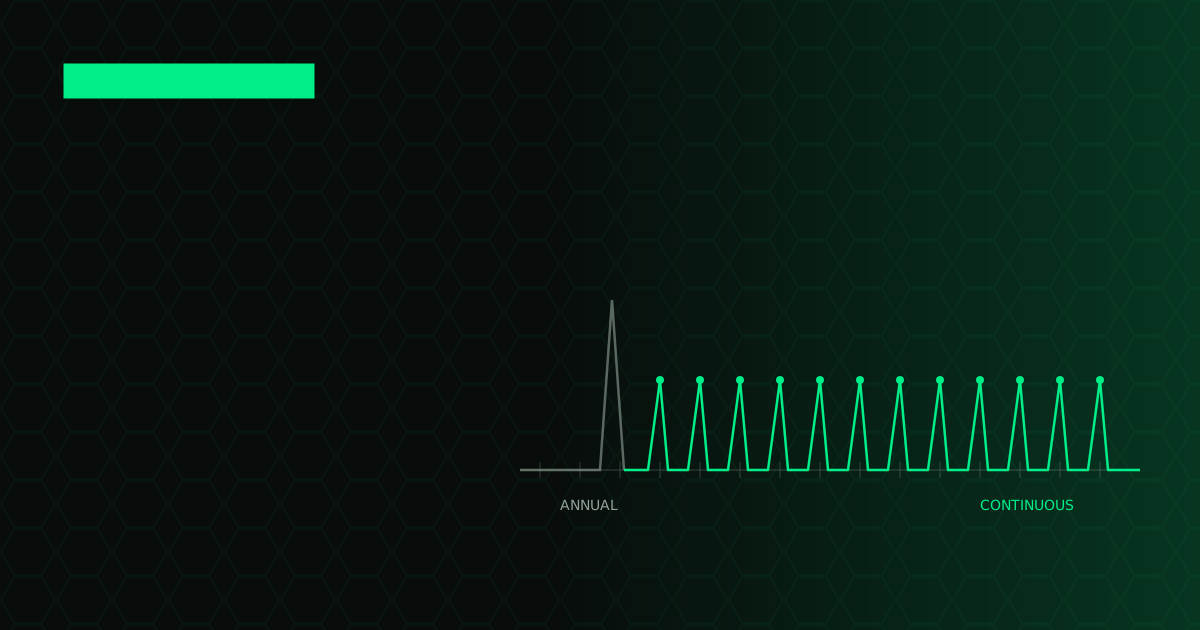
Why security teams are moving from yearly penetration tests to continuous security validation, and how to make the switch without losing depth.
Table of contents
The annual penetration test was designed for software that changed a few times a year. Most teams now deploy daily. Continuous security validation keeps the rigor of a pentest — agreed scope, real exploitation, evidence — but runs it on a cadence that matches how you ship.
The problem with point-in-time testing
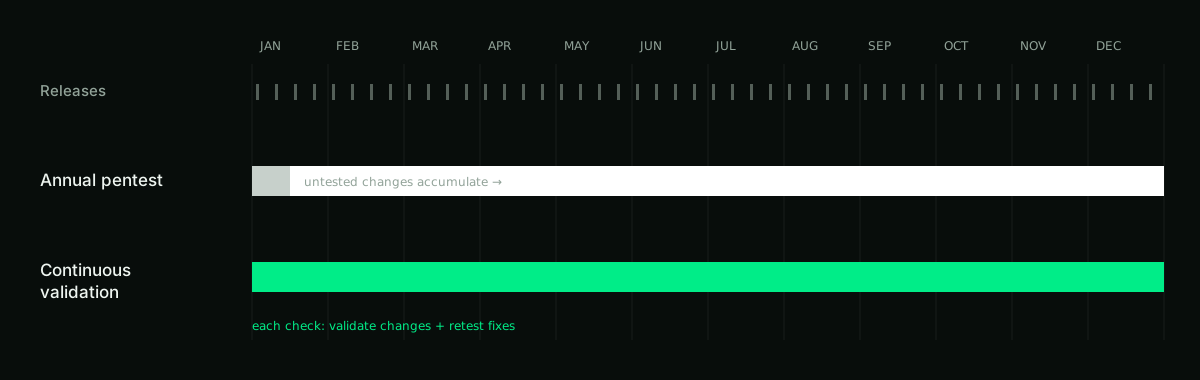
A pentest report describes your attack surface on the day it was tested. Within weeks, new endpoints, roles, and integrations appear. Findings get fixed, but nobody re-verifies them until next year’s engagement.
The result is a familiar gap: compliance is satisfied, but the security team cannot say with confidence which critical paths are open today.
What continuous validation changes
- Cadence: agreed surfaces are revalidated on a schedule and after meaningful changes.
- Retesting by default: every fix is replayed, so "closed" means verified.
- Prioritization by proof: only exploitable issues reach engineering.
- Trend data: you can show how exposure evolves over time, not just a yearly snapshot.
How to switch without losing depth
- Start with your most exposed applications and APIs.
- Keep an annual manual engagement for scenarios that need human creativity.
- Feed validated findings straight into your existing ticketing workflow.
- Report on time-to-fix and retest results, not raw finding counts.

What Is AI Pentesting? How It Works and Where It Fits
AI pentesting explained: how AI agents plan and validate attacks, how they differ from scanners and automated pentest tools, and where humans stay in the loop.
Yassine El Jakani2 min read