
What Is AI Pentesting? How It Works and Where It Fits
AI pentesting explained: how AI agents plan and validate attacks, how they differ from scanners and automated pentest tools, and where humans stay in the loop.
Table of contents
AI pentesting uses AI agents to do what a penetration tester does: explore an agreed scope, form hypotheses about how it could be attacked, try them safely, and keep only what can be proven. The goal is not more findings. It is fewer, verified ones — with evidence an engineer can reproduce.
Scanners, automated pentest tools, and AI agents
These three get conflated, but they answer different questions.
| Vulnerability scanner | Scripted automated pentest | AI pentesting | |
|---|---|---|---|
| Approach | Signature and version checks | Fixed playbooks | Goal-driven reasoning over the target |
| Output | Possible issues | Playbook results | Validated attack paths with proof |
| Adapts to your app logic | No | Rarely | Yes, within scope |
Scanners are fast and broad, and they remain useful. But they cannot tell you whether a misconfiguration combined with a weak API authorization check actually exposes another tenant’s data. That kind of chained reasoning is where AI agents add value.
How an AI pentest runs
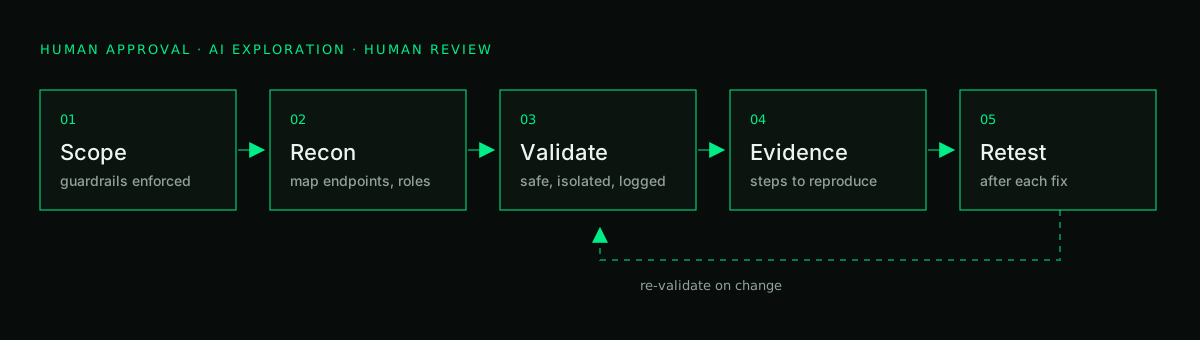
- Scope and guardrails. Targets, credentials, rate limits, and forbidden actions are defined up front and enforced by the platform, not left to the model.
- Reconnaissance. Agents map endpoints, roles, and data flows.
- Hypotheses and safe validation. Agents attempt specific attack steps in an isolated, logged environment and stop at the minimum needed to prove impact.
- Evidence. Each confirmed issue comes with the exact requests, responses, and steps to reproduce.
- Retest. After a fix ships, the same path is replayed to confirm it is closed.
Where humans stay in the loop. People define scope, approve sensitive actions, and review findings before they reach your backlog. AI handles the repetitive exploration that makes manual testing slow and expensive.
When AI pentesting makes sense
- You ship weekly and an annual pentest is out of date within a month.
- Your backlog is full of scanner alerts nobody trusts.
- You need proof for customers or auditors that critical fixes actually hold.
It does not replace every manual engagement. Red-team exercises, physical security, and social engineering still need people.

Continuous Security Validation vs. the Annual Pentest
Why security teams are moving from yearly penetration tests to continuous security validation, and how to make the switch without losing depth.
HEXBOX1 min read